- 10 Nov 2026
- Agent-Based Modeling Education
An Update on Introduction to Complexity & A New Ask
Share your thoughts on what you'd like to see next from Complexity Explorer
Thank you again to everyone who participated in our survey about Introduction to Complexity. Our update of the course is in progress and we look forward to sharing the refreshed version with you in 2027. Many of you told us how valuable the course has been as an introduction to the field, and how often you've returned to it over the years. Where applicable, we’ve passed your messages along to Melanie Mitchell and she sends her thanks for so many lovely notes.
Your responses identified a real challenge — how to train scientists and thinkers who come to complex systems embedded in the methods, language, and frameworks of a home discipline. For us, this raises a broader question about what Complexity Explorer could offer learners next, especially in a rapidly changing digital landscape. We want to honor the role you occupy as a community of complex systems thinkers by asking: How can we help you move from learning the theoretical foundations of complexity science to applying it to ask and explore your own questions?
To that end, we have a short, new survey about what you would most like to see from Complexity Explorer and how the ways you learn are changing. Your responses will help us understand not just what could be improved, but what would be useful to build. Thank you, as always, for helping us to think alongside you.
Agent-Based Modeling: Worlds Within Worlds
A new interactive story from the Santa Fe Institute
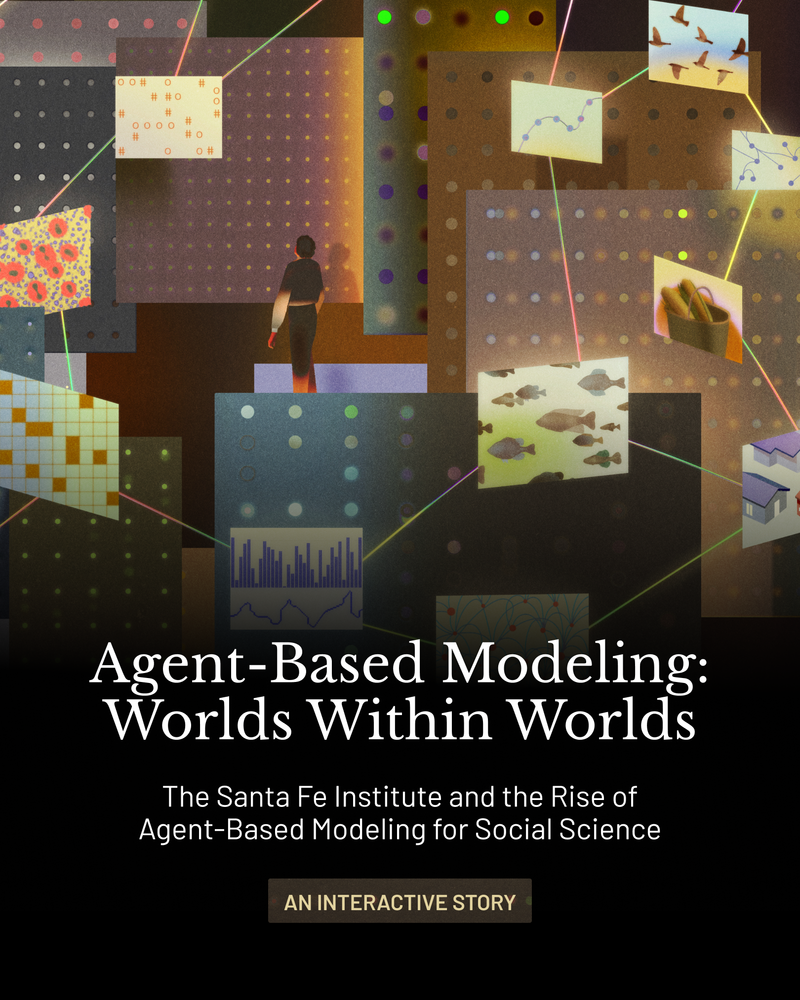
The Santa Fe Institute has published a new interactive story, Agent-Based Modeling: Worlds Within Worlds, tracing the early development of the agent-based modeling method and how it grew from a fringe idea into a powerful tool used across the social sciences, with a focus on SFI’s contributions.
Drawing on input from nearly 20 researchers who contributed to the development of influential agent-based models, the story follows the method through economics, archaeology, public health, and other fields.
It also traces how ballooning computational power and dataset availability helped drive the evolution of agent-based modeling and increase its real-world impact. The story includes several pared-down ABM models readers can run and adjust themselves.
Read the full story and run the models yourself here