- Preview
-
- Title
-
The Abelian Sandpile
- Series
- Self-Organization
- Description
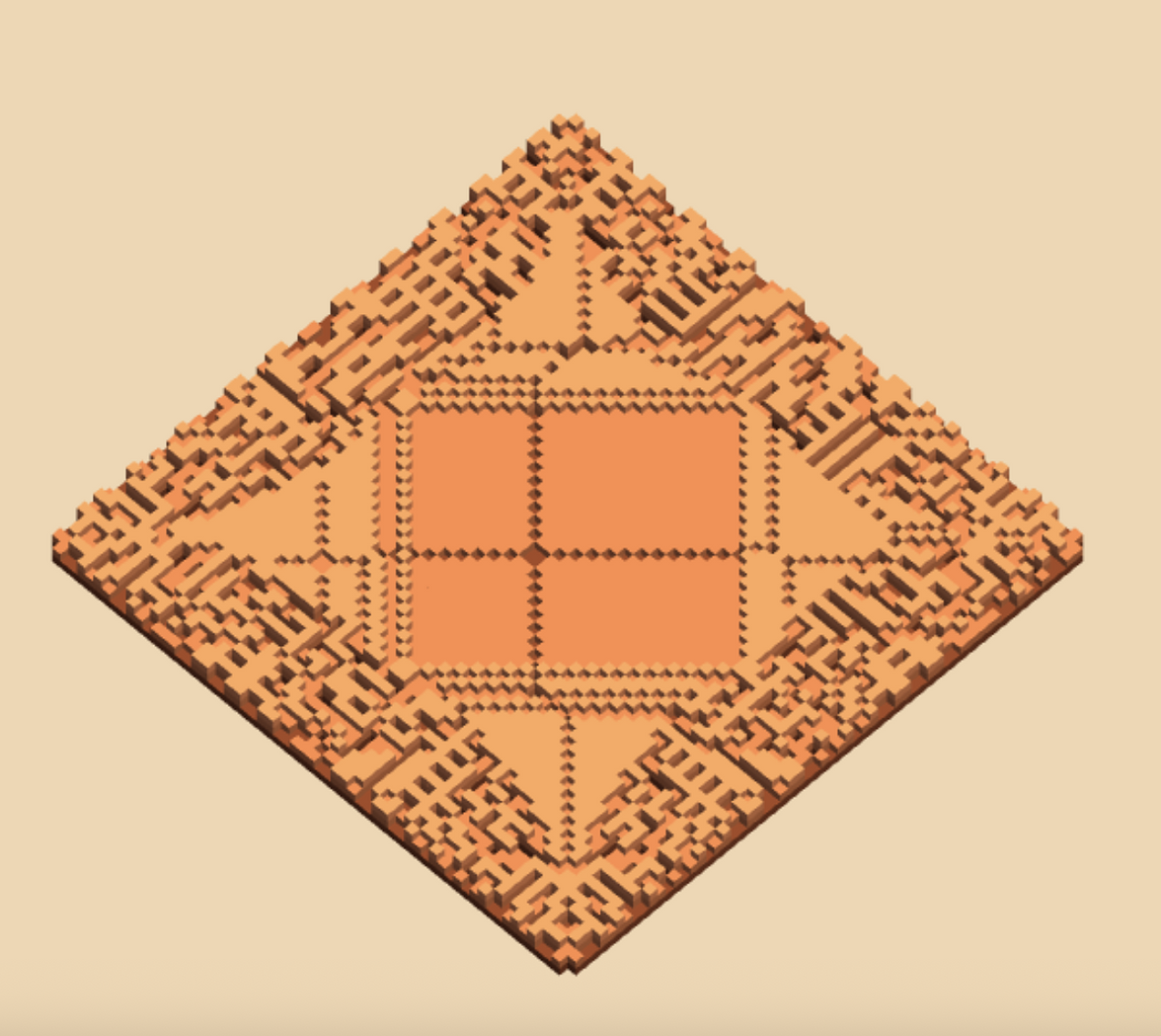
The abelian sandpile model is a simple cellular automaton that demonstrates how complex behavior can emerge from simple rules. Grains of sand are added one at a time to a grid, and when a site exceeds a threshold (four grains), it topples, distributing sand to its neighbors and potentially triggering cascades called avalanches. These local interactions drive the system toward a critical state in which avalanches occur on all scales: small events are common, while large, system-spanning avalanches are rare but always possible. The sizes of these avalanches follow a power-law distribution, as shown in the accompanying histogram.
Introduced in 1987 by Per Bak, Chao Tang, and Kurt Wiesenfeld as the first model of self-organized criticality, the sandpile remains the archetypal example. In 1990, Deepak Dhar showed that the model’s dynamics are abelian: the final stable configuration does not depend on the order in which grains are added or sites topple. As sand is added, the critical state acts as an attractor for the dynamics, with the system continually regulating itself to the boundary between stability and instability. When it is far from critical (for example, nearly flat), added grains simply build it up. As it becomes unstable, avalanches redistribute the grains and keep it balanced at the point of criticality, preventing it from ever becoming too stable or too unstable.
How to interact with the simulation:Press the buttons to advance through the demo. SCROLL to zoom in/out of the grid. Press SPACE to pause the simulation dynamics. After the initial toppling, you can place your own grains: CLICK anywhere on the lattice. Notice that some drops trigger long cascades—avalanches—while others do almost nothing. In really rare cases, an avalanche can span the entire lattice, if a drop happens at the right spot. This spot is called a critical point.
You might think that eventually the pile settles down so that big avalanches become impossible. In fact, one is always possible: the system self-organizes to become more critical over time.Supplementary resources
- Bak, P., Tang, C., & Wiesenfeld, K. (1987). Self-organized criticality: An explanation of 1/f noise. Physical Review Letters, 59(4), 381–384. https://doi.org/10.1103/PhysRevLett.59.381
- Deepak, D. (1990). Self-organized critical state of sandpile automaton models. Physical Review Letters, 64(14), 1613--1616. https://doi.org/10.1103/PhysRevLett.64.1613
- G. Pruessner, "The Physics of Fractals." Foundational Papers in Complexity Science: Volume 3. Edited by David C. Krakauer. The SFI Press Scholars Series, 2024. (pp. 1923–1936).
About the creator
 Jonathan Lin is a Ph.D. student in Electrical Engineering at the University of Southern California, where he studies neuromorphic devices and materials, with a focus on their use in physical realizations of dynamical systems and unconventional computers. Jonathan received a B.S. in Computer Science and an M.Eng. in Bioengineering from the University of Maryland. In addition to his research interests, Jonathan uses his background to create "edutainment": articles, animations and simulations which improve science communication.